From Scam Documentation to Publishing House
Library of Cons #23: New book on Amazon Kindle delivers frontline account of the enforcement gap in Southeast Asia’s scam economy - excerpt included below

Over the past several years, I’ve focused on documenting how modern scam economies function structurally — not just who commits them, but why they persist.
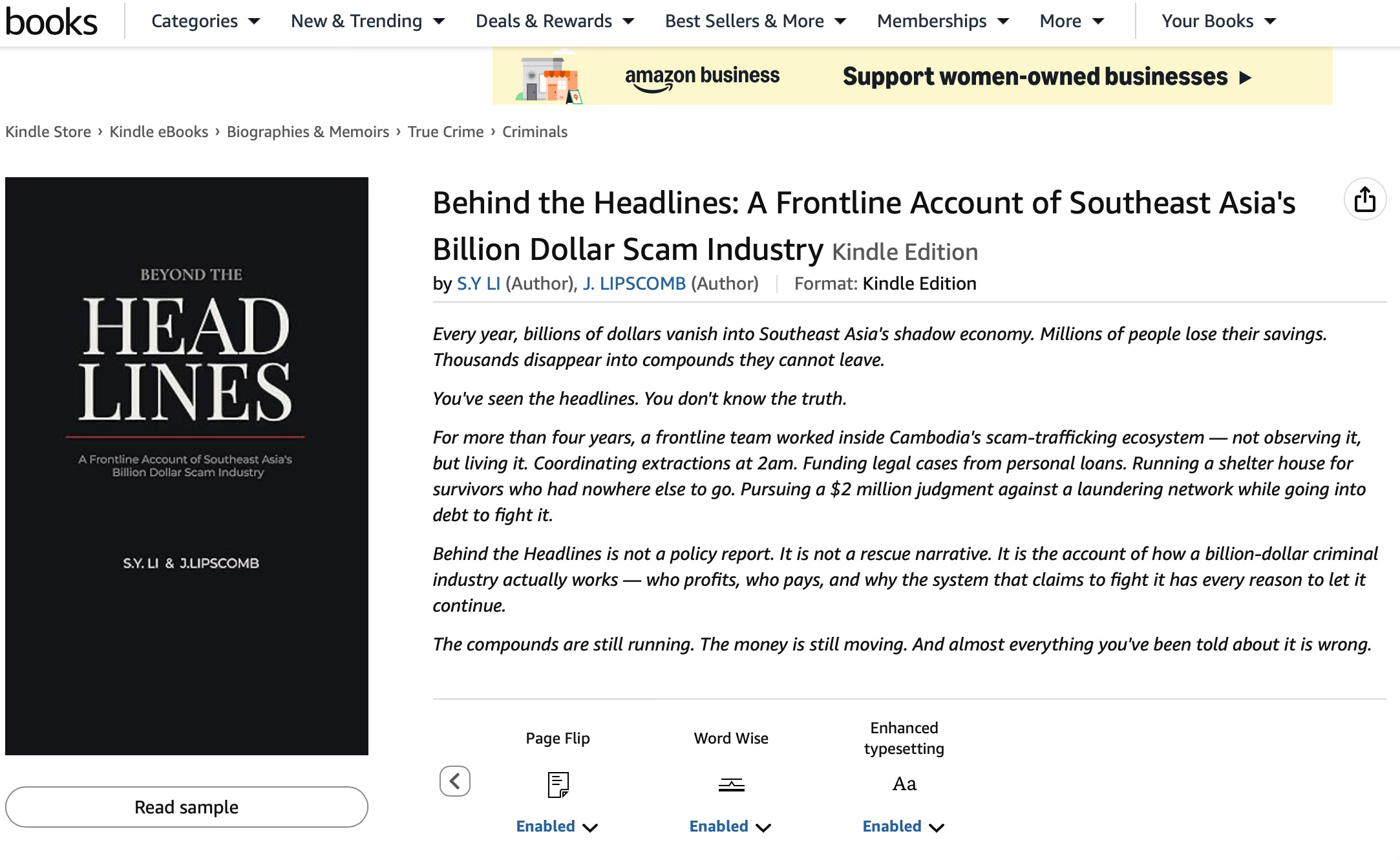
Behind the Headlines: A Frontline Account of Southeast Asia’s Billion Dollar Scam Industry (Available now on Amazon Kindle for $2.99)* is the result of working closely with someone who operated inside Cambodia’s scam-trafficking ecosystem for more than four years. The frontline team at GA-SO worked relentlessly to coordinate extractions at 2am, fund emergency housing from personal loans, and pursue civil judgments against laundering networks that most people never see. My role was to help translate that field documentation into a public record.
Now the the book that delivers a frontline account of Southeast Asia’s billion dollar scam industry has been released on Amazon Kindle. Even after they lost funding late last year for on-the-ground fieldwork, GA-SO continues to offer support services through chat to victims of human trafficking and triages with law enforcement.
I worked alongside the frontline team at GA-SO to shape this book from years of field documentation, operational logs, and direct experience inside Cambodia’s scam-trafficking ecosystem. What follows is a narrative account focusing on the structural reasons the industry persists.
We are providing an excerpt below. We value your feedback and would love for you to review the book. We will be up on Goodreads next week!
Excerpt:
Shelter house existed because there was nowhere else for people to go after leaving the compounds. Those who arrived had already asked for help from every authority they could name—police, embassies, consulates, agencies—and had watched their messages circulate without consequence. In several cases, reporting their exact location did not lead to extraction but to relocation. They were transferred from one compound to another, handled like inventory in a system where human presence was tracked as stock, and each movement clarified the same conclusion: no official mechanism was coming for them. By the time they decided to leave on their own, the idea of rescue had already expired. Escape was not a moment of courage. It was the point at which remaining inside no longer offered the possibility of survival. . .
Shelter house should never have had to exist. If embassies functioned in the way they are imagined to, if emergency response moved at the speed at which danger actually unfolds, if administrative systems were built to recognize situations that do not fit their templates, then there would be no need for a private apartment to become the final bridge between captivity and return. Its existence was not an act of charity. It was evidence of a gap so wide that only whoever happened to be standing there could close it.
What became clear over time was that this kind of work could not exist inside institutional hours. Large organizations are built for accountability, reporting structures, funding cycles, and procedural response, all of which are necessary for governance. But none of those systems are designed for 2 a.m. phone calls, airport benches at midnight, missing passports that must be replaced before morning, or overstay fines that determine whether someone boards a flight or remains stranded. Institutional response moves according to schedule. These cases moved according to danger. The difference was not intention. It was design. The two rarely met.
No formal NGO could operate in this way, not because they lacked commitment, but because they were structured to require authorization before action. The shelter functioned precisely because it did not wait. Decisions were made within minutes. Expenses were covered personally when needed. The only qualification for help was that someone had nowhere else to go and no time left to wait. The house absorbed those who had already fallen through every institutional net, and it held them just long enough for paperwork to catch up with reality.
Responsibility did not end when someone stepped inside. It ended only when they stepped through the departure gate. Each time that happened, relief was physical. Shoulders lowered. Breathing returned. Because until that moment, failure was always possible — a delayed document, an unpaid fine, a small procedural obstacle that could undo everything. The work was exhausting not because it was complicated, but because it never stopped. Sometimes two people arrived at once and there was not enough money to feed both comfortably. Ten dollars, fifty dollars, halal meals that cost more than expected, air-conditioning running through nights because bodies needed cool air after days in heat — all of it fell quietly into personal expense. The house was not an institution. It was a rented apartment that had quietly become a passageway between captivity and return.
This is the part rarely seen. Shelters are imagined as funded spaces with staff and programs. This one was sustained through donations from individuals, unrelated companies, and personal salaries diverted without announcement. By November 2025, that funding ran out. The shelter house closed not because it was no longer needed, but because it could no longer be sustained. Its disappearance did not coincide with fewer escapes. It simply meant that the next person who made it out would have nowhere to go.
The house revealed something uncomfortable about rescue. Rescue is not an event. It is a logistical gap that someone must physically occupy until a person cross from one system into another. Compounds operate continuously. States operate procedurally. Between those two speeds, people fall. The shelter house existed inside that space. It should never have been necessary. But while it existed, many people returned home safely because, for a brief period, someone was willing to stand where no system had been built to stand.
Behind the Headlines: A Frontline Account of Southeast Asia’s Billion Dollar Scam Industry is now available for $2.99 on Amazon Kindle.
If you follow financial crime, trafficking systems, or transnational enforcement gaps, this book was written for you.
Disclosure & Legal Notice
This newsletter is authored by a contributor to Behind the Headlines: A Frontline Account of Southeast Asia’s Billion Dollar Scam Industry, which may be referenced or promoted herein. The author may receive financial benefit from book sales or related materials.
All content is provided strictly for informational and educational purposes and does not constitute legal, financial, investigative, or operational advice. Views expressed are solely those of the author in a personal capacity and do not represent any government, law enforcement agency, or affiliated organization. Certain details may be modified or withheld to protect sources and individuals. Readers should conduct their own independent verification and due diligence before relying on any information presented.
*3/9 note: Version has been taken temporarily offline to add edits. If you are interested in reviewing, get in touch with me at libraryofcons@gmail.com for an ARC copy.